This week, we began reading How To See The World by Nicholas Mirzoeff, and what a start it was. The introduction of the book, also titled “How To See the World” provided an overview of the chapters to come and dealt with five major points:
- The world is constantly changing
- The world is constantly more and more connected through the internet as the first universal medium
- The new definition of visual culture does not just mean what we can see, it means how we connect and interact with what we see and with the world itself
- The change in the world is being wrought through four major alterations: urban populations, young populations, global warming, and connectivity
- The emerging culture is a highly visual one
A Summary:
Following the five points listed above, Mirzoeff uses the famous image of “The Blue Marble”, taken by astronaut Jack Schmitt in the 1972 Apollo Eleven mission, shown in the header, to show how looking at the world from a different perspective can help patch together the knowledge we know and contextualize it in a greater framework. However, from the image, he moves on to explain that the famous picture is no longer a true representation of what the Earth looks like; it has changed rapidly and continues to change at a staggering pace in physical, political, human, and artistic spheres.
This change is also due, Mizroeff continues, to the internet, which makes things like publishing huge amounts of media and reverse searching individuals possible, and which has now connected billions of people worldwide and has led to a more globalized culture, with sub-Saharan Africa and India being the least connected. However, he acknowledges, this does not mean that everyone has the same type of access to the new connectivity, pointing out the difference between the amount of countries accessible by a British passport without a visa and the markedly fewer countries accessible through an Iranian passport.
All of this change has also led to a dramatically different visual culture than was available in the earlier centuries C.E. and has undergone countless changes and movements. In the modern era, Visual culture has increasingly become more widespread and more accessible, though it comes at the cost of a decreasing quality, and the methods through which we spread visual communication still harken back to analogue methods, such as the “click” on a digital camera mimicking the sound an analogue camera makes when its mirror is moved while taking a shot. Visual culture is no longer just about what we see, but also how we interact, and it becomes less about the message of the physical communication and more about the way in which we form new connections around it.
Altogether, these changes are pushed forward and compounded by the world’s population, which are growing more and more urban, and, for the first time in centuries, more people live in cities than in the countryside. The population of the world also becomes more and more connected as billions of videos are uploaded onto platforms like YouTube and trillions of photographs are taken. In addition to this, the rising carbon levels and melting ice lead to rising water, storms, droughts, and massive change on a climate basis. And lastly, the global age pattern is trending towards a base-heavy population pyramid, with young people influencing what Mirzoeff calls a “formula for change.”
And all of this change is taking place in an increasingly visual society, which is creating a new culture of us as humans, with different ideals drawing us into “nations” and an overall “networked society”, which changes our relationships with each other and with the world, making us reimagine what “us” looks like and where we fit within it all.
A Commentary:
This was an extremely broad and comprehensive chapter, touching on all levels of the modern change through and because of visual culture. Overall, I agree with the points made and felt that they were very interesting and worth thinking about. A few things that really struck me about this section had to do with some individual changes to the modern world that affect our view of our lives, the way in which visuals play into it all, the injustice done within this new culture, and what this means for anthropologists, global systems, and for us going forward.
- Individual changes
While individual changes take many forms in this discussion, a key point that stuck with me in this chapter was Mirzoeff’s remark that many people now take for granted that photos in magazines have been photoshopped or altered in some way. How does this then change our reaction to photographs in general? Does it make us much less likely to believe what we see, and, of so, has this contributed to the rise of hoaxes and political bias as seen in the 2016 Trump election and the time since? What does this say about the integrity of work, and does this nullify the effect of it? Do we still compare ourselves to the photoshop and feel like we can never amount to what is being projected, even though we know it is false? Do we now have a paradoxically warped view of the world and do we no longer know what do believe? Many still do feel horrible about themselves looking at photographs of models or actors/actresses that have been altered, as if they momentarily forget that they have been changed, yet still create their own opinions based on their beliefs when engaging in a political system, regardless whether those facts have been falsified or not. The next questions then might be: why do those people allow a negative reflection of themselves? Does society breed this negativity, especially in looks and IQ, and how does that affect how we see ourselves and everyone around us? How does the human ability to choose selectively play into design?
- Visual impact
The change in this new culture has been wrought largely by technology, as Mirzoeff says, “a way to see the world enabled by machines,” and this technology has “flattened the hierarchy of the arts” by making visuals much more accessible to the general population. This is interesting to me because it makes you think twice about the impact of technology and the way we see the world through that. Children today can use a phone before they know what the screen even says or does, and movies and reality shows largely influence our views of ourselves, our lives and of others, sometimes for the better and sometimes for the worse. Visualizing the world also takes the form of photography and the differences between what we see with our eyes and how the photographs turn out. This can create an extreme disconnect and even portray the subject differently to someone who has not developed their own opinions of it. One of the most impactful ideas behind the impact of visuals on the world, however, is how I fit into them as a graphic designer. What can I do to change someone’s view? Do I want to? How? And what are the consequences?
- Injustices Done
Within connectivity in the modern world, Mirzoeff pointed out that not everyone will have access to the same kind of connections, such as with the example of passports. To me, this introduces a facet of the global community I have not previously considered in this way. We as humans tend to stay within our comfort zones, away from potentially haunting scenes or concepts we do not want to consider, whether out of fear of the unknown or of what may happen to us, or guilt. While we may be familiar with not having wifi all the time, many of us have never considered not having any sort of connection, not being able to travel to places we want to go, or not having the ability to be connected to information we need, both because of societal taboos, like sex and menstrual health, and propaganda, such as the restricted internet access in China. Opening up the conversation is incredibly important, and I want to continue exploring it.
- What it Means
All things considered, the question becomes “what now?” How can we get people to think differently through visuals? What works and what doesn’t, and can we learn from YouTube and social media about it? And on a more global and historical sense, what does it mean for the changing of the planet and its population. We are a new “us”, but how will that “us” change our world? We still have wars, invaders, hideous human rights, genocides, nations and nationalities and struggles for secession or autonomy, such as in Palestine, Basque country, Catalonia and Scotland. Does the new “us” make us more aware of what is going on and how we can help? Or does it let us forget and click away to something we find more pleasant to look at? There is an interesting duality to all of this. The internet and the new globalized society makes us more likely to know about things we could not have known about, understanding more cultures and visiting more places, whether through internet or airfare, and gaining more coverage about issues that need fixing. But it also makes us possibly more focused on our own circles and heightens our capability to ignore, which I think is very interesting.
Notable Quotes:
Interesting Stuff
- “Every two minutes, Americans alone take more photographs than were made in the entire nineteenth century.” (p.6)
- “Like it or not, the emerging global society is visual. All these photographs and videos are our way of trying to see the world. We feel compelled to make images of it and share them with others as a key part of our effort to understand the changing world around us and our place within it.” (p.6)
- “The astronaut is invisible and unknowable in his own self-portrait. There is, it seems, more to seeing than being in the place to see.” (p.8)
- (About tiled rendering) “It is a good metaphor for how the world is visualized today. We assemble a world from pieces, assuming that what we see is both coherent and equivalent to reality. Until we discover that it is not.” (p.10)
- “As soon as the shutter closes, that instant is past time.” (p.23)
Constant Change
- “The world today is physically different from the one we see in Blue Marble, and it is changing fast” (p.7)
- “None of these changes are settled or stable. It seems as if we live in a time of permanent revolution. If we put together these factors of growing, networked cities with a majority youthful population, and a changing climate, what we get is a formula for change. Sure enough, people worldwide are actively trying to change the systems that represent us in all senses, from artistic to visual to political.” (p.7)
- “The world we live in now is not the same as it was just five years ago…but more has changed more quickly than ever and, because of the global network society, change in one location now matters everywhere.” (p.13)
Visual Culture
- “Like history, visual culture is both the name of the academic field and that of its object of study. Visual culture involves the things that we see, the mental model we all have of how to see, and what we can do as a result.” (p.11)
- “A visual culture is the relation between what is visible and the names that we give to what is seen. It also involves what is invisible or kept out of sight….we assemble a world-view that is consistent with what we know and have already experienced.” (p.11)
- “Visual culture is now the study of how to understand change in a world too enormous to see, but vital to imagine.” (p.12)
- “Visual culture today is the key manifestation in everyday life of what sociologist \manuel Castells calls ‘the network society’, a way of social life that takes its shape from electronic information networks (1996). It is not just that networks give us access to images – the image relates to the networked life on- and offline and the ways we think about and experience those relations.” (p.13)
- “Simply put, the question at stake for visual culture is, then, how to see the world? More precisely, it involves how to see the world in a time of dynamic change and vastly expanding quantities of imagery, implying many different points of view.” (p.13)
- “The emphasis is no longer on the medium or the message…instead, the emphasis is on creating and exploring new archives of visual materials, mapping them to discover connections between what is visual and the culture as a whole, and realizing that what we are learning to see above all is a change on the global scale.” (p.14)
Cities and Computation
- “The key places in these networks are the global cities, where most of us now live. In these immense, dense spaces, we learn how to see – and also not to see potentially disturbing sites – as a condition for daily survival.” (p.15)
- “The creation of the global city has come at a tremendous cost. Now we have to learn to see the changing world. Or more exactly, we have to become aware of how humans have turned the planet into one enormous artefact, the largest work of art ever made or ever possible.” (p.15)
- “As digital scholar Wendy Hui Kyong Chun puts it, ‘when the computer lets us “see” what we cannot normally see, or even when it acts like a transparent medium through video chat, it does not simply relay what is on the other side: it computes’ (Chun 2011).” (p.18)
- In many cases, what we can ‘see’ in the image, we could never see with our own eyes. What we see is a computation…a way to see the world enabled by machines.” (p.18)
The New Us and the New Network
- “Above and beyond personal possession, far more people can see and share all this material via the Internet, the first truly global medium.” (p.17)
- “There is a new ‘us’ on the Internet, and using the Internet, that is different from any ‘us’ that print culture or media culture has seen before. Anthropologist Benedict Anderson described the ‘imagined communities’ created by print culture so that the readers of a specific newspaper would come to feel they had something in common (1991).” (p.21)
- “Trying to understand the imaged and imagined communities created by global forms of experience is similarly central to visual culture. The new communities that are emerging on- and offline are not always nations, although they are often nationalist.” (p.21-22)
- “From the new feminisms to the idea of the 99 percent, people are reimagining how they belong and that that looks like.” (p.22)
The Arts
- “He flattened the hierarchy of the arts by making a painting or sculpture equivalent in this sense to a photograph or an advertisement.” (p.20) (John Berger, Ways of Seeing)
- “What all moments of visual culture have in common is that the ‘image’ gives a visible form to time and thereby to change.” (pg.22) (In relation to Daguerre’s image of fossils, binding the now with prehistory)
- “Overtaken was also a painting as the most advanced form of modern visual representation. For all of Turner’s brilliance, his painting took weeks to make. A photograph can change the world in just seconds.” (p.24)
The New Now
- “In less than a decade from Daguerre’s fossils, the industrial world had transformed the organization and representation of time and space by means of the new time zones and photography. These changes created a desire for a different system of political representation, a subject perfectly well suited to the new visual medium.” (p.25)
- “The gain in information is offset by the digitally enabled 24/7 work environment for professionals worldwide, while the Chinese who produce the digital equipment that makes the new work regime possible are themselves expected to work 11-hour days, plus overtime if required, with an average of one day off a month. The long struggle to limit the working day has been soundly defeated.” (p.25-26)
- “This vaporizing of millennia has now caused the undoing of the hitherto infinitely slow rhythm of deep time itself. What once took centuries, even millennia, can now be undone in a single human lifetime.” (p.27) (Think of this in relation to the Trump administration and the immediate setback of decades of fighting for rights worldwide via a single pen stroke.)
“Let us remember: One book, one pen, one child, and one teacher can change the world.”
— Malala Yousafzai
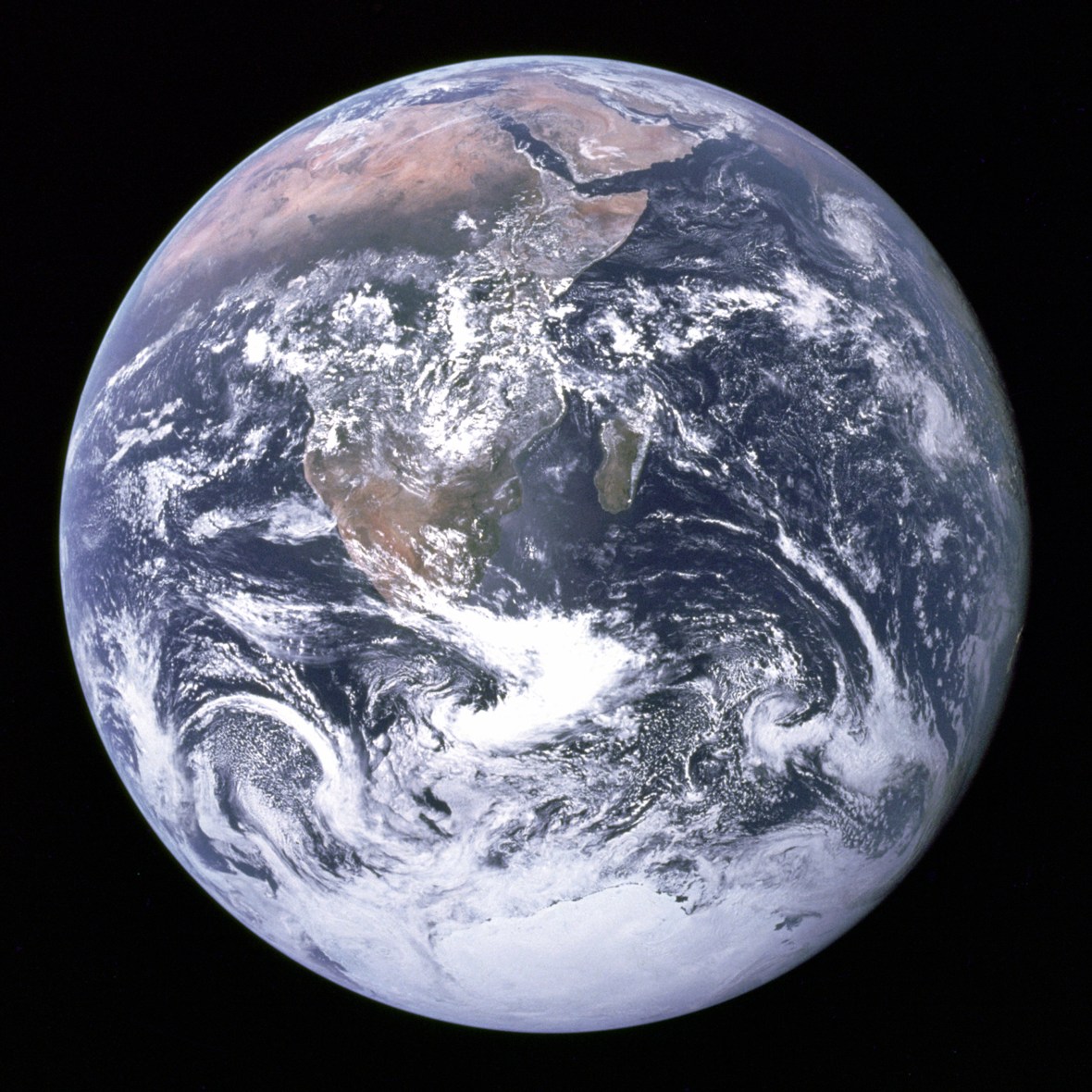
Image taken from https://en.wikipedia.org/wiki/The_Blue_Marble
 Karo.Design